
How to Search Civil Dockets
The Dallas County Courts Portal Smart Search takes a record number. It also accepts a party name typed Last, First Middle Suffix. Filters narrow things by location, search type, case type, status, file-date range, and judicial officer. A case number you already know is the cleanest bridge. It links the portal, a daily docket, and a clerk request. Daily civil dockets show DC and DF prefixes. But Dallas County publishes no complete code guide. So never guess a case category from a prefix alone.
Court labels matter as much as name matches. District civil and family matters generally route to the District Clerk. County Courts at Law civil matters go to the County Clerk. JP cases stay with the correct precinct and place. Federal civil matters run through the Northern District of Texas and PACER.
- Identify the likely court level and gather a case number, party name, or approximate filing period.
- Run Smart Search and narrow by case type, status, dates, location, or judicial officer only as needed.
- Open the matching record and preserve its full case number, court, file date, and status.
- Read events in order from petition and service through motions, settings, judgment, and later activity.
- Check the court's daily docket for a current setting and ask the responsible clerk for a missing or certified document.
Dallas County Civil Docket Custody
No single clerk holds every Dallas County civil record. The District Clerk keeps district civil and family cases. The County Clerk holds county civil and probate records. Justice of the Peace courts handle limited civil claims, eviction, debt, and other matters assigned to their places. The portal opens several categories through one shared front door, but custody never merges.
| Civil matter | Court | Record keeper |
|---|---|---|
| General district lawsuit | District Court | District Clerk |
| Family district case | Family District Court | District Clerk, with access limits |
| County civil action | County Court at Law | County Clerk |
| Small civil, debt, or eviction | Correct JP place | Justice of the Peace court |
| Probate or guardianship | Probate Court | County Clerk |
| Federal civil action | Northern District of Texas | Federal clerk and PACER |
Ask the wrong keeper and you may see no result even though the case exists. Write down the court name first, then request the copy.
What a Civil Docket Shows
Think of a Dallas County civil docket as a chronological index. It can show the case style, file date, parties, attorneys of record, filings, settings, orders, disposition, and post-judgment work. The label is often much shorter than the filed document behind it. A motion is a request, not a ruling. An order-signed entry is not a substitute for the signed order's terms.
| Case Number | The identifier linking the portal result, daily setting, and record request; official examples include DC and DF prefixes. |
|---|---|
| Case Style | The caption formed from the parties or matter title. |
| File Date and Type | When the case opened and its indexed category. |
| Filings and Service | Petitions, answers, returns, waivers, motions, notices, and related events. |
| Settings | Docket calls, hearings, trials, continuances, and resets. |
| Judgment | A final, agreed, default, dismissal, nonsuit, or other recorded disposition. |
| Post-Judgment | Abstracts, writs, garnishment, satisfaction, appeal, or mandate events. |
When the legal effect matters, compare the event register with the operative order. A closed case can still show later activity.
Dallas County Civil Daily Dockets
The individual 116th and 298th District Court pages show how Dallas civil calendars differ. They stand apart from the full case index. Their tables list Party Name, Floor or Court, Time, and Case Number. Pagination can push a setting onto another result page. The daily view answers when and where a matter is listed. It does not show everything filed in it. The 116th District Court daily docket shows that public table pattern.
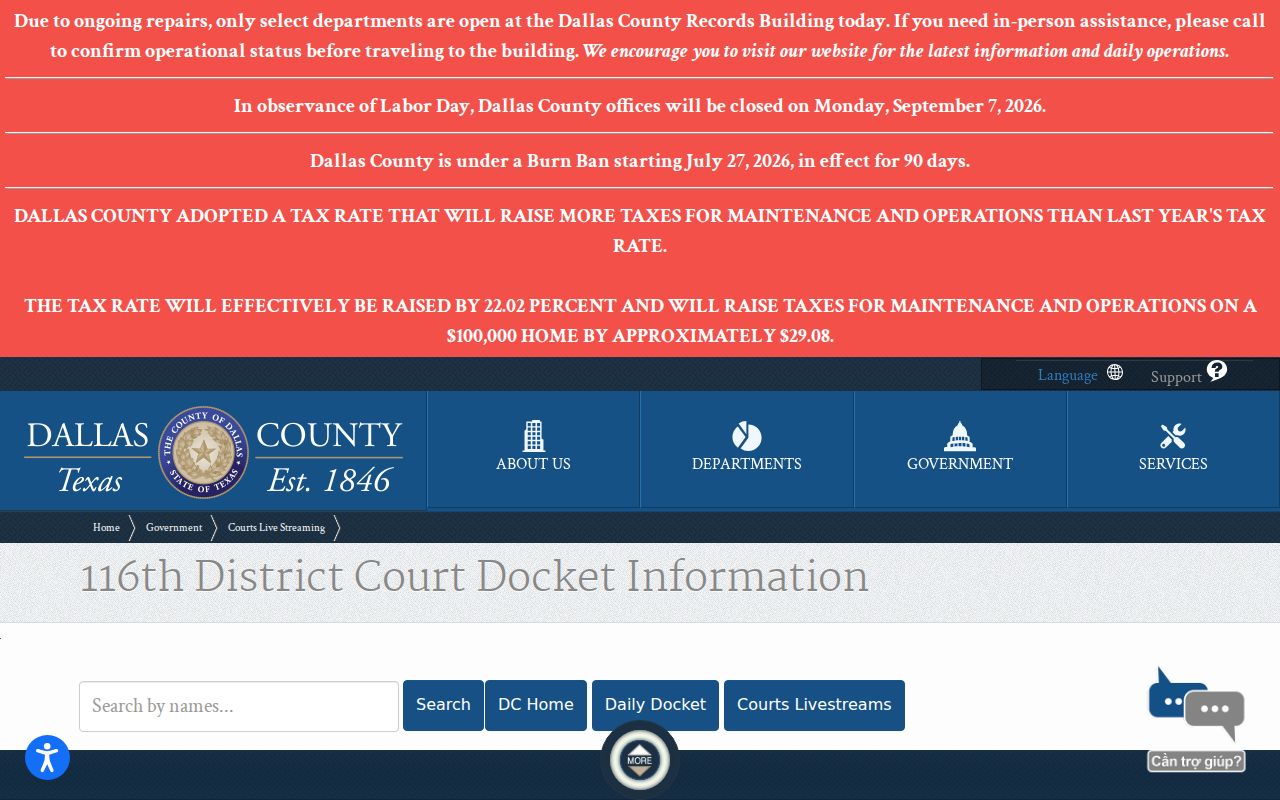
Grab the case number from the table. Carry it back to Smart Search or the clerk when a fuller filing history is needed.
Types of Civil Cases on the Docket
Civil dockets in Dallas County span more than one trial-court tier. District courts handle general civil suits and family matters. County Courts at Law carry their own statutory assignments. JP courts take limited claims, eviction, and debt matters in the correct precinct and place. Probate courts maintain estate, guardianship, and related proceedings through the County Clerk. Federal claims sit outside the county court system.
- Contract, debt, tort, property, and other district civil suits
- Family district matters, often with stricter document access
- County Court at Law civil cases
- JP small civil, eviction, and debt cases
- Probate, estate, and guardianship cases
The route to the right court docket depends on the case type and court label. One party's name can show up in many unrelated matters, so a broad name hit or a street address never settles which court has the case.
Dallas County Civil Docket Stages
A civil case usually opens with a petition or complaint. Citation and service events track formal notice. A short entry may not show the full method, though. An answer, counterclaim, or intervention can change party roles. Discovery disputes and motions may follow. The court then records notices of setting, hearings, trial dates, continuances, and rulings.
Docket flow: Petition › Service › Answer › Motions › Setting › Judgment › Post-Judgment
A judgment can be final, agreed, default, or another form. Nonsuit and dismissal are not always interchangeable. DWOP means dismissed for want of prosecution. But check any reinstatement entry too. Abstract, writ, garnishment, turnover, or satisfaction entries show later work. None replaces the judgment.
- Nonsuit
- A plaintiff's voluntary dismissal of a claim under the applicable procedure.
- DWOP
- Dismissed for want of prosecution; confirm the order and later reinstatement activity.
- Default judgment
- A judgment entered after a response or appearance failure, as the order states.
- Continuance
- A moved setting. It does not rewrite every deadline unless the court also changes them.
Settings and Hearings on Civil Dockets
The event history may list a notice of setting or docket call. Hearing, trial, reset, and continuance entries appear there too. The County Portal's hearing tool searches by location, hearing type, search type, criteria, judicial officer, courtroom, and date range. Settings can change. So compare the result with the individual court's current daily docket and the latest filed notice or order.
The 162nd District Court supplies a key local rule. A Notice of Hearing must be e-filed before the setting is formally placed on its docket. An informal scheduling exchange alone is not a filed notice. For a full date-check workflow, use the Dallas County court calendar.
Dallas County Civil Settlement Settings
A settled case can still sit on the trial docket. The 162nd District Court requires proper notice first. Its procedures say the court must receive the settlement notice or order before taking a matter off the trial docket. Until that filing arrives, the public calendar keeps the setting live. Read the setting and the newest filings together. That habit saves Dallas County litigants real confusion. Think the case settled but a trial date still shows? Search the docket for the required filed notice or signed order. Then contact the court coordinator through the court's current page. Do not assume the calendar is simply stale. A settlement discussion is not a final disposition either. A reset trial date can also leave other scheduling deadlines untouched, so read the court's order and current procedures side by side.
Dallas County Civil Record Years
Coverage years differ by clerk. The District Clerk civil records page reports district civil data reaching back to 1975. Files are available for most civil cases after 2008. Those two statements do not promise the same thing. An indexed older case may carry no public image at all. A newer file can still hold sealed or restricted material. County Clerk Central Records lists separate online ranges for county civil and probate records. It also notes warehouse routes for older files. So a missing PDF in a visible case might be restricted, redacted, paper-only, archived, not yet posted, or held by another clerk. Name the gap before drawing a conclusion.
Public Access to Civil Dockets
Public access to a Dallas County civil docket stops short of full online openness. Family filings face tighter limits. So do children's data, protective-order details, and sealed exhibits. District Clerk guidance keeps sealed and confidential civil or family material offline. A court order is generally required to reach it. Redaction works differently. It can leave an event public on the docket while withholding sensitive fields.
Key rules:
Texas Government Code § 552.0035 says judiciary access is governed by applicable law and Supreme Court rules.
Texas Rules of Civil Procedure 21c and 76a address sensitive-data protection and civil sealing procedure.
Texas Family Code § 85.007 protects certain protective-order details, including specified address and contact information.
Not displayed, redacted, sealed, restricted, and not located each mean something different. Ask the clerk which one applies and whether a court order is required.
Dallas County Civil Copy Choices
A portal image is only a viewing copy. Paper copies from the District Clerk cost $1 per page. Certification runs $5 per document. Exemplification is another $5 per document. Warehouse retrieval adds $5, and a search without a case number costs $5. County Clerk guidance takes a different approach: plain online copies within stated ranges are free. Certification or exemplification there adds $5 per case plus $1 per page, with possible extra certification charges.
| Copy choice | Use | Published charge |
|---|---|---|
| Portal view | Read an available public image | No separate public-view fee found |
| District Clerk paper | Ordinary paper copy | $1 per page |
| District Clerk certified | Clerk-authenticated document | $5 per document plus copy cost |
| District Clerk exemplified | Added authentication | $5 per document beyond certification |
| County Clerk certified or exemplified | Authenticated county civil record | $5 per case plus $1 per page, with possible added charges |
Copy fees and filing fees are separate charges. Ask the receiving office whether it needs a plain, certified, or exemplified copy before you pay.
Dallas County Civil Records Desk
The District Clerk civil records desk sits in basement B West of the George L. Allen, Sr. Courts Building, 600 Commerce Street, Dallas, Texas 75202. Hours run 8:00 a.m. to 4:30 p.m. Monday through Friday. The civil records number is 214-653-6076. County civil access works differently. The County Clerk keeps its own route for County Courts at Law and older closed records. For district civil and family files, the official District Clerk page sets out its custody and access instructions.
District civil and family copy questions belong on this clerk page. County civil cases stay on the County Clerk path.
Dallas County Civil Appeals Route
A state civil appeal from a Dallas County district or county court heads to the Fifth Court of Appeals. That court sits in Dallas. Its appellate docket is a separate world from the trial court's event history. The notice of appeal may appear in the Dallas County civil docket. The appeal itself lives elsewhere. Briefing, submission, orders, and the opinion are tracked in the appellate court's own case system. Federal cases take a different road. Federal civil appeals go to the federal Fifth Circuit, not the state Fifth Court of Appeals. The names sound alike, so the mix-up is easy. Before switching systems, confirm the trial case sat in a Texas state court or the Northern District of Texas.