
How to Search Criminal Dockets
Most felony and misdemeanor case information sits in one place: the Dallas County Courts Portal. Its Smart Search tool takes a record number. It also takes a name typed Last, First Middle Suffix. You can filter by location, case type, status, filing dates, or judicial officer. No attorney registration is needed to browse. The portal itself warns that data may be incomplete or out of date. So treat a result as a route to the case rather than the official court record.
Begin with the sharpest identifier you have. Hang onto the court name, case number, search date, and newest event. Check any current hearing against the court's daily docket. If a document heads to court, ask the proper clerk for a certified copy.
- Classify the matter as felony, county misdemeanor, municipal Class C, or juvenile.
- Search by case number or party name, then add filters needed to distinguish the result.
- Confirm the court, case type, file date, status, and case number.
- Read events in date order, separating charges and settings from pleas, orders, and dispositions.
- Compare the newest setting with the named court's daily docket and request the exact document when needed.
Dallas County Criminal Docket Split
Two offices split the criminal records in Dallas County. Felonies in the district criminal courts rest with the District Clerk criminal section. The County Clerk handles misdemeanors for the county criminal courts. The shared portal makes both look like one system. But custody still decides who can dig up an older file, certify a document, or explain a missing image.
Class C city cases stay with the issuing municipal court. A Justice of the Peace place may hold limited citation matters. Juvenile cases follow a restricted route of their own.
| Matter | Keeper | First route |
|---|---|---|
| Felony indictment | District Clerk | County portal and felony records |
| County misdemeanor | County Clerk | County portal and criminal records |
| Municipal Class C | Issuing city court | City docket channel |
| Juvenile case | District Clerk and court | Restricted route |
What a Criminal Docket Shows
Think of a Dallas County criminal docket as a timeline, not the full evidence file. Smart Search can surface a case number, case type, status, file date, and judicial officer. An event may point to a pleading or an order. The document itself may stay absent. Daily dockets are narrower. They answer who is set, when to appear, and where the court will sit.
| Case Number | The key joining the result, events, settings, and clerk request. |
|---|---|
| Charge | The accusation and displayed class or degree, not proof of guilt. |
| Status | An indexed state that must be read with the latest order. |
| Setting | A date and hearing type, often with time, room, and floor. |
| Event | A filing or system action, sometimes linked to a public image. |
| Disposition | The recorded outcome label, such as dismissal or conviction. |
An online image is never a certified copy. The operative order always carries more detail than a short event label.
Dallas County Criminal Daily Dockets
Each day, the Criminal Courts Daily Docket lists Party Name, Date, Time, Room, and Floor. It is great for confirming one day's appearance. It is not the whole event history. An empty table proves nothing about whether a criminal case exists, so search the case portal and the individual court page too.
The official felony page lays out the scope and records role of the District Clerk.
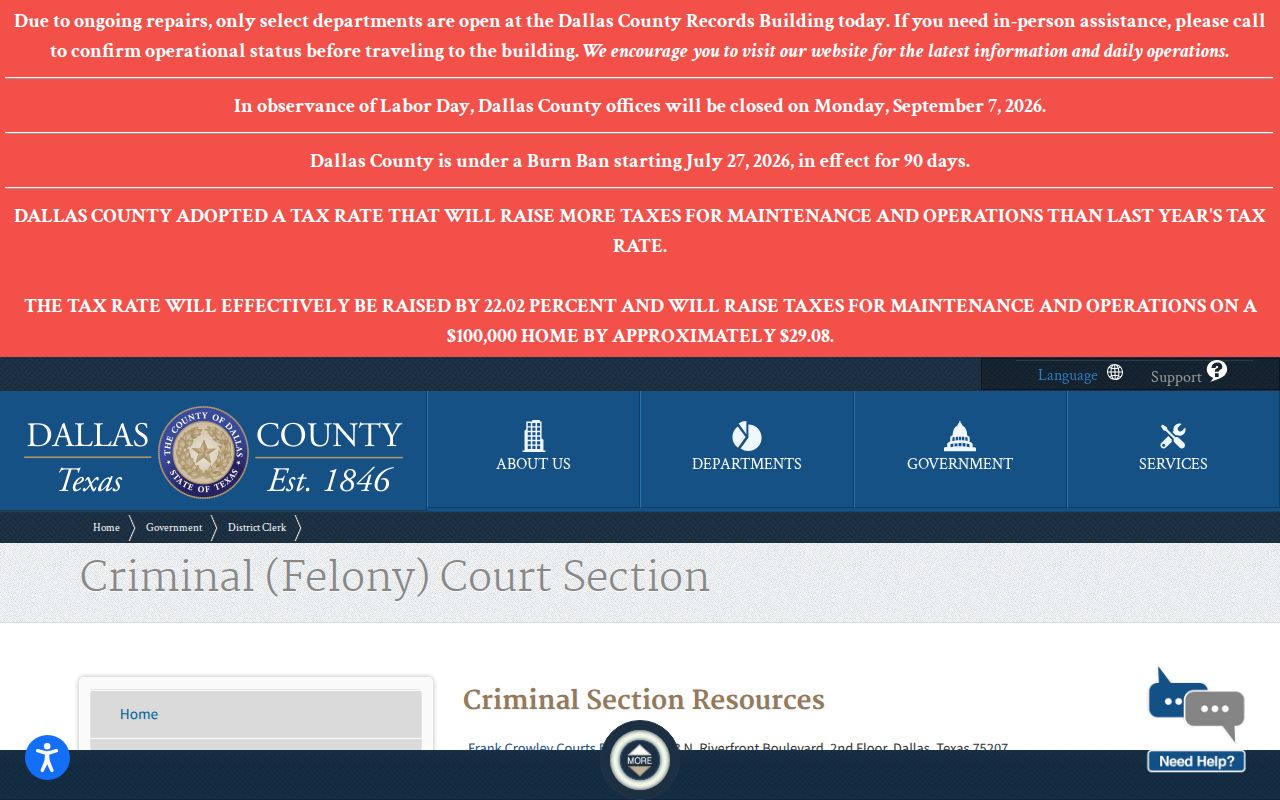
This view sorts felony records work from the county misdemeanor and city court channels.
Stages on a Criminal Docket
Early entries often reflect a complaint, information, indictment, or case opening. An arraignment or initial appearance pulls the charge into the plea process. Bond entries concern release or compliance, never the merits. Pretrial settings may record motions, discovery issues, status checks, or a reset. A trial setting only means a date landed on the calendar. It does not show that trial occurred.
Docket flow: Filing › Arraignment › Pretrial › Plea or Trial › Disposition › Sentencing
After disposition, the Dallas County criminal docket can pick up judgment, sentence, probation-review, appeal, mandate, or modification entries. Read through to the newest event. A pending status is not a result, and a reset is not a conviction.
Dallas County Criminal Docket Terms
Dallas public pages publish no complete Odyssey codebook. Rely on the full description in the result, and treat short forms as reading aids only.
- Nolle prosequi
- A prosecution-abandonment label, not an acquittal.
- Deferred adjudication
- A disposition with conditions whose order controls the terms.
- Capias
- A warrant-related process that does not prove present custody.
- Bond forfeiture
- A bond-compliance process, not a conviction.
- Reset
- A moved setting whose newest date must be confirmed.
- Closed
- A system status that may coexist with later records.
Which Court Holds Criminal Dockets
Felonies travel through district criminal courts after Grand Jury receipt. The District Clerk supports the records there. The official page counts 17 district courts in the felony system. County criminal courts hear misdemeanors under County Clerk custody. For names and places, the criminal district directory lists the named criminal and auxiliary courts.
The court label drives your next step. Felony questions go to the District Clerk criminal section at Frank Crowley, 133 N. Riverfront Boulevard, Dallas, Texas 75207. You can also call 214-712-3088. County misdemeanor records follow the County Clerk route at Frank Crowley, second floor, Room A-1. That office answers at 214-653-7099. Do not force municipal, JP, or juvenile cases into either adult county route.
Dallas County Felony Docket Conversion
Felony operations left a 1976 mainframe behind. They moved to Windows and Odyssey in May 2023. The District Clerk reported roughly 2,314,823 felony cases converted, some reaching back to 1968. That figure is a historical conversion inventory. It is not annual filings, and it is not the current pending caseload.
The county warned of conversion errors and reporting concerns. A gap may mean data work, not a removed case. Save the access date, case number, URL, and screen message before turning to the public-access support form.
Dallas County Criminal Docket Errors
E-filers in Dallas County ran into a warning in January 2026: an Odyssey Custom Business Rules deployment could push some submissions into an error queue. Docket searches can fail too, for humdrum reasons. A blocked cookie can stop a query cold. Weak JavaScript can too. So can an odd browser setting, or a session that times out. None of this means a filing disappeared.
Start over with a narrow search. Then pull the daily docket for the court named on the case. If a technical error persists, write down the case number. Note what went wrong, the document involved, and the URL you visited. The support form asks for those exact fields. A filing problem follows the District Clerk's felony e-filing route. A copy problem goes to whichever clerk owns the case.
Note: Save the exact error and the access date before you retry. A later successful search can hide what caused the mismatch.
Public Access and Sealed Criminal Dockets
Plenty of adult criminal indexes in Dallas County are open to the public. Still, access has limits. Non-disclosure information stays off the ordinary District Clerk path, and juvenile records get stronger protection. Local practice generally limits those files to attorneys of record and litigants. A signed court order must allow more. A blank result can mean the wrong clerk was checked. It may also point to an older paper record or an indexing delay rather than a sealed case.
Access rules:
Texas Government Code § 552.0035 places judiciary access under applicable law and Supreme Court rules.
Texas Rule of Judicial Administration 12 governs judicial-record requests but distinguishes case records.
Texas Family Code Chapter 58 supplies the juvenile confidentiality framework.
Sealed, restricted, redacted, not displayed, and not located are five different conditions. Asking a clerk to unseal a record does not work; that takes a court.
Dallas County Criminal Copy Routes
Reading a docket online is not the same as holding the file. It is not an authenticated copy either. The District Clerk certifies felony records. For misdemeanors, the County Clerk offers plain online copies for many cases from 2011 forward, subject to current service notices. Records closed long ago may need an in-person visit, mail, email, or a warehouse request.
Put your request in writing. Include the case number, court, case style, exact document date, desired format, and certification need. A misdemeanor name search through the County Clerk is not a certified copy. It does not come from a known file. The Dallas County case search walks through the field-by-field lookup to finish before ordering.
Dallas County Criminal Court Directory
Once a docket search points to a specific court, the district directory earns its keep. Each court's page may carry a daily docket and the coordinator's name. It may also list the courtroom and current procedure. Those details shift. Let the case label lead you to the court page rather than a guess. The official directory lays out the current public court structure.
It connects a case result to the court calendar or contact that verifies a setting.
Dallas County Case Information Limits
A Dallas County criminal docket is case information, nothing more. It is not a full criminal-history report. The District Clerk's criminal FAQs say so plainly. A county result tracks one prosecution in one court. It does not reach every Texas county, each city court, federal courts, or restricted matters. An empty search does not prove no case ever existed.
Use the docket to confirm the court's entries, the setting, and the recorded outcome. When you need formal proof, request the exact judgment, dismissal, or other record from its keeper. The court's disposition label is narrow. It should never get swapped for a broader conclusion about a person or events.
Dallas County Criminal Certification
Certification splits by case type in Dallas County. Felony requests belong to the District Clerk. Misdemeanor requests belong to the County Clerk. Give the case number, court, document title, event date, format you want, and the kind of authentication needed. That detail keeps a request from crossing clerk lines just because both case types showed up in the same portal.
Dallas County Criminal Docket Checks
Check before you trust a result. Compare the case number, court name, charge label, newest setting, and disposition entry. Each item should match what the court actually shows. Then open the controlling public order or ask the clerk for it. That brief check stops a moved setting, a pending motion, or a status code. None of those should be read as the final result.